
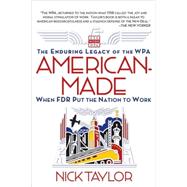
American-Made The Enduring Legacy of the WPA: When FDR Put the Nation to Work
by TAYLOR, NICKEdition: Reprint
Format: Paperback
Pub. Date: 2009-02-24
Publisher(s): Bantam
 Other versions by this Author
List Price: $24.00
Buy New
Special Order. We will make every effort to obtain this item but cannot guarantee stock or timing.
$23.98
Rent Book
Select for Price
Digital
$4.99*
Used Book
We're Sorry
Sold Out
Summary
Seventy-five years after Franklin D. Roosevelt's New Deal, here for the first time is the remarkable story of one of its enduring cornerstones, the Works Progress Administration (WPA): its passionate believers, its furious critics, and its amazing accomplishments. The WPA is American history that could not be more current, from providing economic stimulus to renewing a broken infrastructure. Introduced in 1935 at the height of the Great Depression, when unemployment and desperation ruled the land, this controversial nationwide jobs program would forever change the physical landscape and social policies of the United States. The WPA lasted eight years, spent $11 billion, employed 8 million men and women, and gave the country not only a renewed spirit but a fresh face. Now this fascinating and informative book chronicles the WPA from its tumultuous beginnings to its lasting presence, and gives us cues for future action.
Author Biography
Nick Taylor is the author of seven nonfiction books and collaborated with John Glenn on his memoir. He lives in New York City.
From the Hardcover edition.
From the Hardcover edition.
Excerpts
Chapter One
The End of Jobs
In 1932, the United States faced the greatest crisis in its history short of war. The American industrial powerhouse that had emerged at the end of the Great War in Europe had fallen still. The stillness had progressed from the stock market, which had lost almost 90 percent of its value since the awful crash of October 1929, to the nation’s factories, and from the factories to city avenues, small-town streets, and out across the countryside, where it reached farmers who were mired in a crisis of their own, caused by debt and drought. Workers from every walk of life were idle, one-quarter of the workforce—13 million men and women, though some estimates ranged to 15 million and above. As their resources dwindled, they descended a spiral from belt-tightening to despair to destitution. Millions lost their homes, wore their clothes into rags, and had to forage like animals for food: city dwellers fought for scraps in garbage cans and dumps, while in the country, the hungry scratched for roots and weeds.
For all of the physical suffering, the greatest loss was to the spirit. People felt fear, shame, despair; the suicide rate soared, and the nation trembled at the prospect of a dark, uncertain future. The optimism that Americans had distilled from the promise of the Constitution and learned to take as their birthright—their dreams—had disappeared with their access to work.
This did not have to happen. That it did was dictated by a revered American political philosophy that denied the central government a role in addressing social problems. In the so-called New Era, which began in 1921 and spanned the Republican presidencies of Warren G. Harding, Calvin Coolidge, and now Herbert Hoover, business interests effectively ran the country with some friendly advice from Washington, primarily in the form of useful information. The right data, gathered by the government, would allow banks to adjust their loan portfolios and manufacturers their production schedules, thereby achieving greater efficiencies than they had attained on their own. Labor was a commodity, like iron ore or cotton, to be purchased on the open market at the cheapest price. It was outlandish to think that employers would have any interest in their employees beyond their productive capacity, and even odder to think that the federal government would interfere by telling them how to treat their workers. As for human health and welfare, these were private matters. Society understood that there would always be a few unfortunates who could not—or chose not to—work and take care of themselves, and for these stragglers local governments and private charities were expected to lend a helping hand. It was certainly not Washington’s job to feed and clothe people or give them employment. The government had an interest in promoting social goals, since a healthy, well-fed, stable nation provided a good business climate, but that was all.
“The sole function of government,” Hoover had said in the fall of 1931, two years after the crash, “is to bring about a condition of affairs favorable to the beneficial development of private enterprise.” His predecessor, Coolidge, had put it more succinctly (a practice for which he was famous; his nickname was “Silent Cal”): “The chief business of the American people is business.”
But the New Era had failed, and Hoover’s efforts to revive it had been fruitless. Babe Ruth had put the president’s performance into harsh perspective. Early in 1930, the New York Yankees slugger was holding out for a contract that would pay him $80,000 a year. When sportswriters reminded him that the president made $75,000, Ruth responded, “What’s Hoover got to do with it? Besides, I had a better year than he did.”
And conditions were not improving. Businesses conti
The End of Jobs
In 1932, the United States faced the greatest crisis in its history short of war. The American industrial powerhouse that had emerged at the end of the Great War in Europe had fallen still. The stillness had progressed from the stock market, which had lost almost 90 percent of its value since the awful crash of October 1929, to the nation’s factories, and from the factories to city avenues, small-town streets, and out across the countryside, where it reached farmers who were mired in a crisis of their own, caused by debt and drought. Workers from every walk of life were idle, one-quarter of the workforce—13 million men and women, though some estimates ranged to 15 million and above. As their resources dwindled, they descended a spiral from belt-tightening to despair to destitution. Millions lost their homes, wore their clothes into rags, and had to forage like animals for food: city dwellers fought for scraps in garbage cans and dumps, while in the country, the hungry scratched for roots and weeds.
For all of the physical suffering, the greatest loss was to the spirit. People felt fear, shame, despair; the suicide rate soared, and the nation trembled at the prospect of a dark, uncertain future. The optimism that Americans had distilled from the promise of the Constitution and learned to take as their birthright—their dreams—had disappeared with their access to work.
This did not have to happen. That it did was dictated by a revered American political philosophy that denied the central government a role in addressing social problems. In the so-called New Era, which began in 1921 and spanned the Republican presidencies of Warren G. Harding, Calvin Coolidge, and now Herbert Hoover, business interests effectively ran the country with some friendly advice from Washington, primarily in the form of useful information. The right data, gathered by the government, would allow banks to adjust their loan portfolios and manufacturers their production schedules, thereby achieving greater efficiencies than they had attained on their own. Labor was a commodity, like iron ore or cotton, to be purchased on the open market at the cheapest price. It was outlandish to think that employers would have any interest in their employees beyond their productive capacity, and even odder to think that the federal government would interfere by telling them how to treat their workers. As for human health and welfare, these were private matters. Society understood that there would always be a few unfortunates who could not—or chose not to—work and take care of themselves, and for these stragglers local governments and private charities were expected to lend a helping hand. It was certainly not Washington’s job to feed and clothe people or give them employment. The government had an interest in promoting social goals, since a healthy, well-fed, stable nation provided a good business climate, but that was all.
“The sole function of government,” Hoover had said in the fall of 1931, two years after the crash, “is to bring about a condition of affairs favorable to the beneficial development of private enterprise.” His predecessor, Coolidge, had put it more succinctly (a practice for which he was famous; his nickname was “Silent Cal”): “The chief business of the American people is business.”
But the New Era had failed, and Hoover’s efforts to revive it had been fruitless. Babe Ruth had put the president’s performance into harsh perspective. Early in 1930, the New York Yankees slugger was holding out for a contract that would pay him $80,000 a year. When sportswriters reminded him that the president made $75,000, Ruth responded, “What’s Hoover got to do with it? Besides, I had a better year than he did.”
And conditions were not improving. Businesses conti
Excerpted from American-Made: The Enduring Legacy of the WPA: When FDR Put the Nation to Work by Nick Taylor
All rights reserved by the original copyright owners. Excerpts are provided for display purposes only and may not be reproduced, reprinted or distributed without the written permission of the publisher.
An electronic version of this book is available through VitalSource.
This book is viewable on PC, Mac, iPhone, iPad, iPod Touch, and most smartphones.
By purchasing, you will be able to view this book online, as well as download it, for the chosen number of days.
Digital License
You are licensing a digital product for a set duration. Durations are set forth in the product description, with "Lifetime" typically meaning five (5) years of online access and permanent download to a supported device. All licenses are non-transferable.
More details can be found here.
A downloadable version of this book is available through the eCampus Reader or compatible Adobe readers.
Applications are available on iOS, Android, PC, Mac, and Windows Mobile platforms.
Please view the compatibility matrix prior to purchase.