
 Other versions by this Author
This book presents a series of research articles written over the past four decades by leading economists George J. Borjas and Barry R. Chiswick. Borjas and Chiswick are leading experts on the adjustment of immigrants in their destination country and their impact on the economy. Although they worked separately throughout their careers, and did not always agree, their intellectual interaction has greatly increased understanding of the economic consequences of international migration and immigration policy across developed immigrant receiving countries. This volume brings together their contributions for the first time to demonstrate how public policy issues on immigration have evolved over time.
An in-depth analysis of the key issues relating to international migration Foundations of Migration Economics explores the assimilation of immigrants, focusing on the earning changes of immigrants with a longer duration in the host economy; how immigrant networks and ethnic enclaves influence the labor market and linguistic adjustment of immigrants; determinants of language proficiency and to what extent pre-migration skills are effectively employed by the destination; and the effect of immigration on the earnings of earlier waves of immigrants and native-born workers.
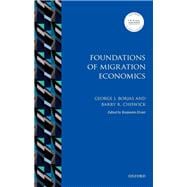
Foundations of Migration Economics
by Borjas, George J.; Chiswick, Barry R.; Elsner, BenjaminFormat: Hardcover
Pub. Date: 2019-04-14
Publisher(s): Oxford University Press
List Price: $128.00
Buy New
Usually Ships in 5-7 Business Days
$127.87
Rent Textbook
Select for Price
Digital
$98.39*
Used Textbook
We're Sorry
Sold Out
Summary
Author Biography
George J. Borjas, Robert W. Scrivner Professor of Economics and Social Policy, Harvard Kennedy School, Harvard University,Barry R. Chiswick, Professor of Economics and International Affairs, Department of Economics and Elliott School of International Affairs, George Washington University
George J. Borjas is the Robert W. Scrivner Professor of Economics and Social Policy at the Harvard Kennedy School. He was awarded the IZA Prize in Labor Economics in 2011. Professor Borjas is a Research Associate at the National Bureau of Economic Research and a Research Fellow at IZA. He is the author of several books, including Immigration Economics (Harvard University Press, 2014), Heaven's Door: Immigration Policy and the American Economy (Princeton University Press, 1999), and the widely used textbook Labor Economics (McGraw-Hill, 2016), now in its seventh edition. His latest book is We Wanted Workers: Unraveling the Immigration Narrative, (W.W. Norton, 2016). He has also published over 150 articles in books and scholarly journals. In 2016, Politico listed Professor Borjas #17 in the list of the 50 "thinkers, doers and visionaries transforming American politics...For telling it like it really is on immigration".
Barry R. Chiswick is a Professor of Economics and Professor of International Affairs at the George Washington University, Washington, D.C. He has published numerous scholarly books, research articles, book chapters, and op-ed newspaper articles. He has received numerous awards for his pioneering research in Labor Economics, with an emphasis on human capital, income distribution, the adjustment and impact on the host economy of immigration, the economics of language, and the human capital and labor market achievements of racial, ethnic, and religious minorities, among other topics. Professor Chiswick has had an impact on the public policy debate on international migration through his research, op-ed newspaper and magazine articles, his testimony before both houses of the U.S. Congress, his media interviews, and his consulting for various government agencies.
Benjamin Elsner is an Assistant Professor of Economics at University College Dublin. His main research lies at the intersection of labor economics, public economics and microeconometrics. While his earlier work mainly studied the economic impacts of migration, his current research agenda focuses on the determinants of people's investment in human capital and the impact of these investments on life outcomes such as health, educational attainment and success in the labor market. Before joining UCD, Elsner acted as a Senior Research Associate at IZA in Bonn, where he focused on migration and integration topics. He continues to serve as IZA Deputy Program Co-ordinator of the Labor Mobility program area. He is also a research fellow at the Centre for Research and Analysis of Migration (CReAM) and the Geary Institute for Public Policy.
Table of Contents
Part I: Introduction by the Editor
Part II: Assimilation
1. The effect of Americanization on the earnings of foreign-born men
2. Assimilation, changes in cohort quality, and the earnings of immigrants
3. Is the new immigration less skilled than the old?
4. Seld-selection and the earnings of immigrants
5. Human capital and the labor market adjustment of immigrants: testing alternative hypotheses
6. Are immigrants favorably self-selected? An economic analysis
7. The 'negative' assimilation of immigrants: a special case
Part III: Ethnic networks and neighborhoods
8. The self-employment experience of immigrants
9. Differences in education and earnings across racial and ethnic groups: tastes, discrimination, and investments in child quality
10. Ethnic capital and intergenerational mobility
11. Ethnicity, neighborhoods, and human-capital externalities
12. Ethnic networks and language proficiency among immigrants
13. Do enclaves matter in immigrant adjustment
Part IV: Language and human capital
14. Speaking, reading, and earnings among low-skilled immigrants
15. Educational mismatch: are high-skilled immigrants really working in high-skilled jobs, and what price do they pay if they are not?
Part V: Impact on the economy
16. The economic benefits from immigration
17. The labor demand curve is downward sloping: reexamining the impact of immigration on the labor market
18. Does immigration grease the wheels of the labor market
19. Native internal migration and the labor market impact of immigration
Part VI: Our view on migration
An electronic version of this book is available through VitalSource.
This book is viewable on PC, Mac, iPhone, iPad, iPod Touch, and most smartphones.
By purchasing, you will be able to view this book online, as well as download it, for the chosen number of days.
Digital License
You are licensing a digital product for a set duration. Durations are set forth in the product description, with "Lifetime" typically meaning five (5) years of online access and permanent download to a supported device. All licenses are non-transferable.
More details can be found here.
A downloadable version of this book is available through the eCampus Reader or compatible Adobe readers.
Applications are available on iOS, Android, PC, Mac, and Windows Mobile platforms.
Please view the compatibility matrix prior to purchase.