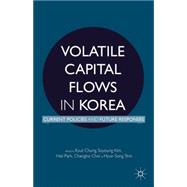
Following on the heels of the devastating Asian Contagion of 1997, Korea went through a painful restructuring process and adopted a new international policy framework based on prescriptions for enhancing macroeconomic performance under free capital mobility. The country also accumulated a huge amount of foreign exchange reserves. Yet in spite of these efforts, Korean capital markets suffered tremendous turmoil during the global financial crisis.
Volatility in Korean Capital Markets summarizes the Korean experience of volatile capital flows, analyzes the economic consequences, evaluates the policy measures adopted, and suggests new measures for the future. This edited collection examines how volatile capital flows have affected the macro economy and financial markets in Korea. The editors evaluate key crisis prevention policies adopted before the global financial crisis and discuss problems in the FX swap and cross-currency swap markets. This cutting-edge work features two of the macro-prudential measures adopted in recent years, and suggests long-term indicators for improving the resilience of the Korean financial system.
Kyuil Chung is Director General at the Bank of Korea. He served as Deputy Director General of the Economic Research Institute at the Bank. He has written numerous papers about international finance, monetary policy, and financial stability. His works are published in IMF, BIS, MIT Press, Tsinghua Financial Review, and many more.
Soyoung Kim is Professor in the Department of Economics at Seoul National University. He has received research awards such as Arnould O. Beckman Research Award, Tae Sung Kim Research Award, Chung Ram Research Award, and was listed as one of the 100 most promising talents of Korea by Donga-Daily Newspaper.
Hail Park is a Senior Economist at the Bank of Korea. He has published articles in Journal of Empirical Finance, Journal of Futures Markets, Emerging Markets Finance & Trade, Applied Economics Letters, National Institute Economic Review. His research interests include financial economics, macroeconomics, international finance, and financial econometrics.
Changho Choi is a Research Economist at the Bank of Korea, and his research focuses on capital flows, macroprudential policies, and unconventional monetary policies.Hyun Song Shin is Professor of Economics at Princeton University. Dr. Shin's research interests include financial institutions and risk and financial stability issues.
Preface
Contributors
Tables and Figures
Part I: Overview
1 Overview of International Capital Flows - Kyuil Chung, Hail Park, and Changho Choi
Part II Capital Account Liberalization and Its Consequences
2 Macroeconomic Effects of Capital Account Liberalization: the Case of Korea - Soyoung Kim, Sunghyun H. Kim, and Yunjong Wang
3 Do Capital Inflows Matter to Asset Prices? The Case of Korea - Soyoung Kim and Doo Yong Yang
4 Capital Flows in Korea after Capital Account Liberalization - Hail Park, Daeyup Lee, and Kyuil Chung
Part III: Policy Responses before and during the Crisis
5 Capital Inflows and Policy Responses: Lessons from Korea's Experience - Kyuil Chung and Seungwon Kim
6 Dislocations in the Won-Dollar Swap Markets during the Crisis of 2007–09 - Naohiko Baba and Ilhyock Shim
Part IV: Macroprudential Policy after the Crisis and Institutional Reform Suggestion
7 Why Macroprudential Policy? Brief Overview - Valentina Bruno and Hyun Song Shin
8 Assessing Macroprudential Policies in Korea - Changho Choi
9 Mitigating Systemic Spillovers from Currency Hedging - Kyuil Chung, Hail Park, and Hyun Song Shin
Part V: Epilogue
10 The Second Phase of Global Liquidity and Its Impact on Emerging Economies - Hyun Song Shin
Index

 Other versions by this Author